The best learning toy gives a three-year-old something to do again, in a slightly different way. A tower can become a house. A shape can become a wing. A story can turn into a game.
I would choose one toy that fits the child's current interests before buying a shelf of toys marked educational. The five picks below cover different kinds of play. You do not need all five.
Five picks, five different jobs
| Toy | Why I would choose it |
|---|---|
| MAGNA-TILES Classic 32 | Open-ended building with shapes |
| LEGO DUPLO | Sturdy builds and pretend play |
| Melissa & Doug Pattern Blocks and Boards | Quiet shape matching |
| ThinkFun Roll and Play | A simple shared game with movement |
| Yoto Player | Stories and songs a child can choose |
1. MAGNA-TILES Classic 32: my first pick for building
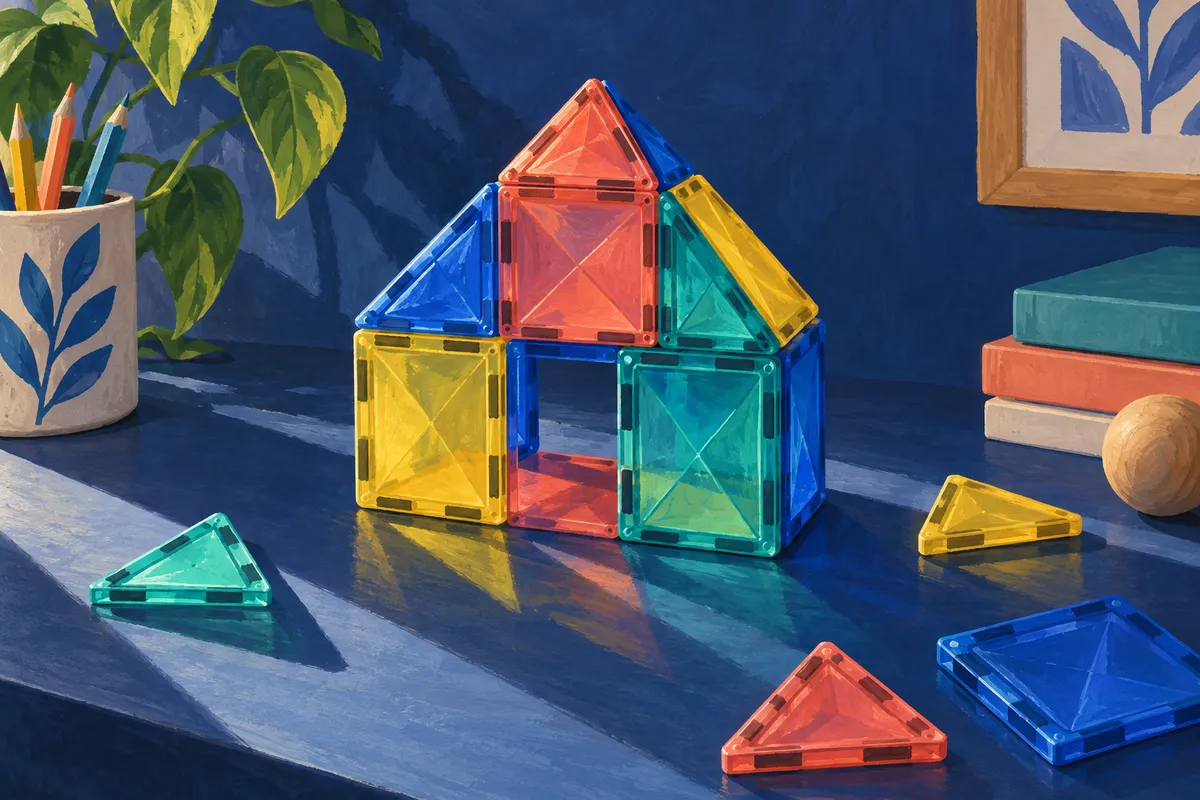
I would start with the MAGNA-TILES Classic 32-Piece Set for a child who likes to stack, sort, and make small worlds. The brand lists it for ages three and up. The mix of squares and triangles leaves room for more than one answer.
My first play idea would be simple: make a flat shape, then see if it can stand up. Let the child change it. A structure that falls can lead to a useful question about a wider base, without turning play into a lesson.
The drawback is that magnetic builds can fall apart. That is part of the play for some children and a source of tears for others. Thirty-two pieces also set a limit on large builds. I would start there before paying for a bigger set.
In a parent discussion about magnetic tiles and DUPLO, families described different preferences. Some liked the quick builds and flat storage of tiles; others found large bricks sturdier. That is a useful buying distinction, not a reason to own both.
2. LEGO DUPLO: for a build that needs to stay together
LEGO DUPLO is my choice for a child who wants to make a house, animal home, or vehicle and then play with it. The larger bricks suit small hands better than standard tiny bricks. Follow the age label on the exact set.
Choose a set with pieces the child can use in more than one way. A familiar theme can help start a story, but a huge themed build is not needed. A small wall and a figure can be enough.
I would ask the child to build a home with room for two animals. If only one fits, there is a reason to change the design. That gives the task a purpose without asking the child to copy an adult model.
The tradeoff is hand effort. Pressing bricks together and pulling them apart can take help. If a child wants fast, loose builds, magnetic tiles may feel easier. If falling towers upset them, DUPLO may suit them better.
3. Pattern Blocks and Boards: for a quiet table task
The Melissa & Doug Pattern Blocks and Boards set includes 120 wooden shapes and five double-sided boards. It is labeled for ages three and up.
I like the clear starting point. The child can match a shape to a space, turn it, and see what fits. After that, the same pieces can make a new picture without a board.
Put out a small number of pieces first. A full pile can make a simple task feel busy. Try making half a butterfly and ask the child what could go on the other side. Or sort the shapes by color without using a picture at all.
The main drawback is cleanup. There are many loose pieces, and small shapes need care around younger siblings. I would keep this as a table activity in a tray, with an adult nearby.
4. ThinkFun Roll and Play: for taking turns together
ThinkFun Roll and Play uses a soft colored cube and activity cards. Its age guide starts at 18 months, so it can still suit a three-year-old who enjoys simple actions and shared play.
I would choose this over a complex board game when the aim is to take turns, follow a short prompt, and laugh together. You can keep the session brief and stop before the child tires of it.
The game's parent guide encourages adapting play to the child. There is no need to insist on a perfect answer. A movement or a silly face can be enough to keep the game going.
The limit is its simplicity. A child who wants a harder puzzle may lose interest. This is a shared game, so I would not buy it as a way to keep a child busy alone.
5. Yoto Player: for a child who loves to listen
Yoto Player gives a child physical cards to choose stories and songs. The third-generation model is listed for ages three to twelve and up. An adult handles the app and first setup.
I would choose it for a child who already asks to hear stories. Start with a few familiar choices. A child can listen while drawing or playing, but there is no need to keep sound on all day.
Its drawback is cost. The device is one purchase; a growing card library can be another. New content also needs to download before it works offline. Our full Yoto Player review explains that setup and the buying tradeoffs.
How I would choose just one
Look at the play that already happens. A builder may want bricks. A child who sorts small objects may like pattern blocks. A child who asks everyone to join in may get more from a simple game.
Then think about the room. Can the toy stay out for a while? Is there a place to store loose pieces? Will an adult be free to play? These details often decide how much use a toy gets.
Use the maker's age label, inspect pieces, and keep damaged toys out of play. Store small parts away from younger children. With magnetic tiles, stop using a piece if its casing is damaged or a magnet is loose.
For older children ready for a formal puzzle-based math course, our Beast Academy review covers the next kind of decision. At three, there is no prize for rushing to that stage.
My final pick
MAGNA-TILES Classic 32 would be my first choice for open-ended play, provided the child likes building and the age label fits. I would choose DUPLO instead for sturdier builds, or one of the quieter picks for a child who prefers a small, clear task.
Buy for the child in front of you. A toy that gets used in three simple ways is worth more than one that promises twenty skills and stays in its box.